How to Size an Irrigation Pump: GPM, PSI and Head (Worked Example)
How do I calculate which irrigation pump I need? You need three numbers: the flow the biggest zone that runs at one time asks for (GPM), the total pressure the pump must deliver (PSI = pressure at the sprinkler + friction loss + elevation), and the suction lift if the water sits below the pump. Compare those against the pump curve, not against horsepower.
Most badly bought irrigation pumps fail for the same reason: they were chosen by horsepower (HP) or by price, and nobody worked out how much water at what pressure was actually needed. This guide lets you do that math on a sheet of paper, using the units you will see on Amazon listings. If you do not yet know which type of pump fits (submersible, surface, jet or booster), read the comparison of pump types first and come back here to size it.
The units, in one table
| Unit | Equals |
|---|---|
| 1 GPM (gallon per minute) | 3.785 liters per minute = 60 GPH |
| 1 PSI | 0.0689 bar = 6.895 kPa = 0.703 meters of water column |
| 1 bar | 14.5 PSI |
| 1 foot of water column | 0.433 PSI |
| 1 PSI | 2.31 feet of water column |
The last row is the one you will use most: every 2.31 feet (0.7 m) you have to lift water costs 1 PSI, regardless of pump size.
Step 1: the flow you need (GPM)
A pump does not water "the yard": it feeds one zone at a time. If your controller opens one zone at a time (the normal setup), size the pump for the most demanding zone, not for the sum of all of them.
- Add up the flow of every emitter in that zone. The figure is on each sprinkler's or dripper's data sheet. As a rough order of magnitude, spray heads typically use 0.5 to 2 GPM each, rotors 1 to 5 GPM, and drip is rated in gallons per hour, not per minute. Always use your own model's manufacturer number, which can fall outside those ranges.
- Measure the real flow if the water is already available: open the zone, fill a 5-gallon (19 liter) bucket with a stopwatch running, and compute
GPM = 60 × gallons ÷ seconds. If the 5-gallon bucket fills in 30 seconds, you have 10 GPM. It is the cheapest way to learn how much water your source gives you today. - Compare against the source. A small shallow well or a 1/2 HP jet pump will not sustain 15 GPM no matter how thick the discharge hose is.
Step 2: the pressure each emitter needs (PSI)
Each emitter works well within a pressure range at the emitter itself, not at the pump. Typical values, always subject to your model's data sheet:
- Spray heads: around 20 to 30 PSI.
- Rotors: around 30 to 50 PSI.
- Drip: 10 to 30 PSI at most; it is almost always reduced with a regulator (the Orbit 30 PSI regulator with filter in this catalog is exactly that part).
If pressure at the emitter comes up short, the sprinklers will not cover the radius they promise. If it is too high, the water comes out misted, blows away in the wind and is wasted. Before buying anything, measure the pressure you already have with a spigot pressure gauge (under $10, screws on without tools): if you already have 45 PSI and your sprinklers ask for 30, you probably do not need a pump at all.
Step 3: the total pressure the pump must deliver
The pump has to overcome four things, and they all add up in PSI:
Total pressure = pressure at the emitter
               + friction loss in the pipe
               + elevation gain (feet × 0.433)
               + suction lift (feet × 0.433)
               + losses in valves and fittings
Friction loss. The thinner the pipe, the longer the run and the more flow, the more pressure you lose. Calculated with Hazen-Williams for PVC pipe (C = 150), the approximate loss at 10 GPM is about 2.4 PSI per 100 feet in 1-inch pipe (Schedule 40) and about 0.6 PSI per 100 feet in 1¼-inch pipe. These are reference values: for your case, check the pipe manufacturer's loss chart. Practical tip: stepping up from 1" to 1¼" on a long run is often far cheaper than buying a bigger pump.
Elevation. If the zone sits higher than the pump, add 0.433 PSI per foot of difference. If it sits lower, it helps by the same proportion (but do not rely on that discount to squeeze the calculation to the limit).
Suction lift. If the pump sits above the water (a surface pump drawing from a cistern or a shallow well), it has to suck, and that has a physical ceiling: at sea level, the atmosphere cannot raise water more than about 34 feet (10.3 m), and in practice jet and surface pumps work well up to about 20 to 25 feet (6 to 7.6 m) of suction. Deeper than that, the answer is a submersible pump inside the well, not a bigger surface pump.
Valves and fittings. Every solenoid valve, filter and elbow takes away a few PSI. Use each part's manufacturer loss figure; if you do not have it, reserve a margin of a few PSI for the run.
It is worth adding a safety margin on top of the result (leaving around 10 to 20% is common), because pumps wear and pipes foul.
Cavitation: the suction limit isn't just "how high water can be lifted." If a surface pump sounds like it's grinding gravel, loses flow suddenly, or the motor vibrates more than usual, the problem is almost always cavitation: on the suction side, pressure drops so much that the water forms vapor bubbles that then collapse violently inside the pump, wearing down the impeller over time. It happens more often than you'd think when the suction lift is near the theoretical limit (the water is too deep or too far away), when the suction pipe is too narrow or has too many elbows, or when there's an air leak at a fitting on that pipe. The fix isn't forcing the pump harder — it's shortening or upsizing the suction pipe, sealing the fittings, or, if the source is genuinely deep, switching to a submersible pump, which pushes water up instead of sucking it.
Worked example: a 4-rotor zone from a cistern
Case data (made up for the calculation, use your own):
- A zone with 4 rotors at 2.5 GPM each → 10 GPM.
- Each rotor needs 35 PSI at the sprinkler.
- The farthest rotor is 150 feet from the pump through 1-inch pipe.
- The zone is 12 feet higher than the pump.
- The pump sits 10 feet above the water level in the cistern.
- Valve and fittings: we reserve 4 PSI.
The math:
| Item | PSI |
|---|---|
| Pressure at the rotor | 35.0 |
| Friction: 150 ft × 2.4 PSI/100 ft | 3.6 |
| Elevation: 12 ft × 0.433 | 5.2 |
| Suction: 10 ft × 0.433 | 4.3 |
| Valve and fittings | 4.0 |
| Total | ≈ 52 PSI (about 120 feet of head) |
With a 10% margin: 10 GPM at about 57 PSI. You can check this math, and try your own numbers, in the irrigation pump calculator. That is the working point the pump must cover, and only now can you look at products:
- The ECO-WORTHY diaphragm booster gives 4 GPM at 50 PSI: it falls short on flow (4 versus 10 GPM). It is for one hose with weak pressure, not for this zone.
- The WAYNE SWS50 shallow-well jet pump delivers up to 420 GPH, about 7 GPM, with a 30-50 PSI switch: it does not reach 10 GPM at 57 PSI either.
- Of the pumps in this catalog, the AQUASTRONG 1.5 HP self-priming surface pump is the one marketed for lawn sprinklers and the only one in the conversation for a case like this. Our catalog does not publish its curve, so before buying it ask the seller for the curve and verify it delivers 10 GPM at about 62 PSI.
If the math gives you a working point that no cheap pump covers, the way out is almost always to split the zone: two 5 GPM zones need a far more modest pump than one 10 GPM zone, and your controller waters them one after the other. That is where a multi-zone WiFi controller pays off.
Example 2: a drip-irrigated vegetable bed, not sprinklers
Drip isn't sized the same way as the sprinklers above: each dripper is rated in GPH (gallons per hour), not GPM, because the flow per point is much smaller.
- A bed with 20 drippers at 1 GPH each → 20 GPH total.
- Converted to GPM (divide by 60, since 1 hour = 60 minutes): 20 ÷ 60 ≈ 0.33 GPM.
- Kits like the CARPATHEN 100 ft or the MIXC 50 ft already ship limited to 20-45 PSI inlet pressure — with flow this low, what you need to work out isn't a pump, it's the inlet pressure.
At 0.33 GPM (versus the 10 GPM in the example above), an average house's hose bib pressure (40-80 PSI) is far more than enough: with drip, the problem is almost never "not enough pressure," it's too much pressure for the emitter to handle. That's why the part that solves most drip-kit cases isn't a pump, it's the Orbit 30 PSI pressure regulator with filter — bringing pressure down, not up. A small diaphragm booster pump like the ECO-WORTHY only comes into play if the source has no mains pressure (an elevated tank, a cistern) or if the line feeds a very large number of drippers at once — for the typical bed or planter in this example, adding a pump would be spending on a part you don't need.
Read the curve, not the number on the box
A pump does not have "a" flow rate: it has a curve that says how much flow it delivers at each pressure. The higher the discharge pressure, the less flow. That is why "12 GPM" in a title can be misleading: it is the flow at one point on the curve.
An example from this catalog: the Red Lion RL12G05-2W1V delivers 12 GPM at 40 feet of depth and 30 PSI, with a maximum pumping head of 212 feet. If your well is 80 feet deep or you need 50 PSI at the surface, that same pump no longer delivers 12 GPM. To know how much it delivers, you have to go to the manufacturer's curve and find your working point. It is the figure most often skipped when buying, and the one that saves the most regrets.
Quick rules for reading it:
- Mark your flow on the horizontal axis (10 GPM in the example).
- Go up to the curve and read the pressure or head (in PSI or feet) the pump gives there.
- That pressure must be greater than or equal to the total you calculated. If it is lower, the pump does not make it.
- Ideally your point falls in the middle section of the curve, not at either extreme.
What completes the installation
With the pump chosen, three parts decide how long the setup lasts:
- Pressure switch: turns the pump on and off by itself. The Square D FSG2J24CP 40-60 PSI is the reference for well pumps, and remember that neither the Red Lion nor the WAYNE includes one.
- Pressure tank: without a tank the pump cycles on and off every few seconds (short cycling) and the motor burns out sooner. The Amtrol WX-202 20-gallon comes pre-charged to 38 PSI, 2 PSI below the cut-in of a 40-60 switch.
- Foot valve: on a well or cistern suction line it keeps the pump from losing its prime between uses. The H2O PRO 3/4" brass one goes on the end of the suction pipe.
Our pick
Do the math above before you look at the price. To see how today's options compare on flow and price, check the Pumps ranking. And if you already have the pressure and only need to automate when it waters, the solenoid valve guide and the WiFi controller guide can save you the pump.
Frequently asked questions
How many GPM does an irrigation system need? It depends on the zone that runs at one time: add up the flow of all its sprinklers or drippers. As a reference, a zone of four 2.5 GPM rotors needs 10 GPM. To measure the flow you already have, fill a 5-gallon bucket with a stopwatch: GPM = 60 × 5 ÷ seconds.
How many PSI does an irrigation pump need? The pressure the sprinkler asks for, plus what is lost in the pipe and in elevation. Typical values at the emitter: 20 to 30 PSI for spray heads, 30 to 50 PSI for rotors and 10 to 30 PSI for drip. In this guide's example, 35 PSI at the rotor becomes about 52 PSI at the pump (57 with the safety margin).
How high can a surface pump lift water? Suctioning water, a surface pump works well up to about 20 to 25 feet (6 to 7.6 m) below it, though the physical limit at sea level is around 34 feet. Deeper than that you need a submersible pump inside the well. Pushing water uphill, every 2.31 feet of elevation costs 1 PSI.
Is more horsepower (HP) always better? Not necessarily. HP tells you how much power the motor has, not how much water it delivers at your working pressure. Two 1 HP pumps can deliver very different flows. What matters is the curve: flow against pressure.
Can I water the whole yard with one pump? Yes, but almost never all at once. The usual approach is to split the yard into zones and water them one after another with a controller, so the pump only has to cover the most demanding zone. That allows a smaller, cheaper pump.
Why does my pump sound noisy but deliver little water? That's the classic symptom of cavitation: suction is at its limit (too deep, a narrow pipe, too many elbows, or an air leak at a fitting) and the water forms vapor bubbles that collapse inside the pump, wearing down the impeller. Check the suction pipe's fittings first, and if the source is very deep, consider a submersible pump instead of forcing a surface pump.
Related products
See full ranking →
AQUASTRONG 1 HP Submersible Pump — 4,500 GPH
This is a drainage/removal pump (built to empty pools, basements, or wells), not a constant-pressure pump for sprinklers. It works well for lifting water from a cistern or well into the rest of the system, but if you need steady, sustained pressure for several sprinklers running at once, the surface pump below is better suited for that.
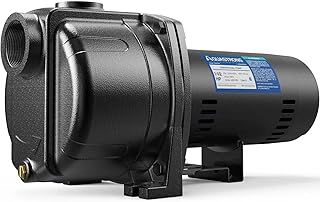
AQUASTRONG 1.5 HP Self-Priming Surface Pump
A centrifugal/jet surface pump, self-priming with a cast-iron body, specifically marketed for lawn sprinklers and garden irrigation — unlike the submersible pump above, it's built to deliver constant pressure, not just move water from one point to another. It's noticeably more expensive; it makes sense if your system genuinely needs extra pressure (check your mains pressure first before investing here).

ECO-WORTHY 33-Series — 4.0 GPM 50 PSI Diaphragm Booster Pump
A diaphragm pump (not centrifugal like the surface pump in this ranking) — it starts and stops on its own via a built-in pressure switch, on demand. Unlike the submersible (drainage) and self-priming surface pump (constant pressure for multiple sprinklers), this is a lightweight, portable booster for a single hose or low-pressure watering point: 4.0 GPM, 110V AC. The pressure switch isn't fixed at 50 PSI — per the official manufacturer manual it's adjustable between 45 and 70 PSI with a screw, and it has thermal overload protection that shuts it off automatically if it overheats past 70°C/158°F (it needs 15-20 minutes to cool down before restarting). It includes garden hose adapters.