Submersible vs. Surface Pump: Which One Your Irrigation Actually Needs
"I need a pump for irrigation" is like saying "I need a tool to fix the house" — it depends entirely on what problem you actually have. A submersible pump, a surface pump, and a diaphragm booster pump solve three completely different things, and buying the wrong one means either overspending or staying short on pressure anyway.
First: where is the water coming from, and where does it need to go?
That question alone answers 80% of the decision:
- Do you need to pull water out of a well, cistern, sump, or flooded basement and move it elsewhere? That's drainage/extraction — a submersible pump.
- Does water already reach you through the mains, but there isn't enough pressure for several sprinklers to run at once? That's constant pressure — a surface pump.
- Is it just one hose or one watering point that's weak, while the rest of the house is fine? That's a localized problem — a lightweight booster pump, not the other two.
Submersible pump: moving water, not pressurizing it
It sits literally submerged in the water it needs to move — a well, a cistern, a tank. Its job is to pull that water out and push it to another point (a hose, an elevated tank, the rest of the system). It isn't built to hold constant pressure across a sprinkler network — once the water reaches its destination, its job is done.
The AQUASTRONG Submersible Pump 1 HP (4,500 GPH) in this ranking is exactly that: built for drainage and extraction, not for pressurizing sprinklers. If your plan is to feed a drip or sprinkler irrigation system directly with it, you'll likely come up short on sustained pressure — that's what the next option is for.
For smaller jobs — a flooded basement window well, draining a pool or a small pond — you don't need to pay for the 1 HP version's 4,500 GPH. The AQUASTRONG Submersible Pump 1/2 HP (3,159 GPH) is the same brand at lower power and price, though with a much shorter track record (152 reviews versus thousands for the 1 HP version) — for deep wells or large flooded basements, the 1 HP remains the more proven bet.
Surface pump: constant pressure for the whole system
It sits outside the water source (hence "surface"), draws from it, and pushes with constant pressure across the whole irrigation network. This is what you need when your municipal or well pressure isn't enough for two or three sprinklers to run at once without each one losing force.
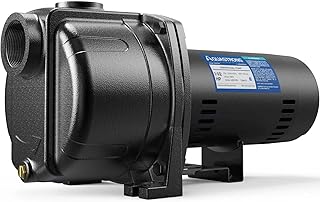
The AQUASTRONG Self-Priming Surface Pump 1.5 HP in this ranking is built specifically for this — cast iron housing, self-priming (no need to manually fill it with water before every start), marketed specifically for lawn sprinklers. It's notably more expensive than the submersible ($349 vs. $59) and the booster — before buying it, measure your actual line pressure with a cheap gauge at the spigot. If you're at 40-50 PSI and several open sprinklers lose pressure together, that's where this pump pays for itself. If your pressure is already fine, you're paying to solve a problem you don't have.
If your water source is specifically your own shallow well (not the mains, and no deeper than 25 feet), the WAYNE SWS50 in this ranking handles extraction and pressure in one smaller, cheaper unit than the AQUASTRONG above — 1/2 HP, also cast iron, $299.89. The real difference versus the AQUASTRONG: it isn't self-priming out of the box — you fill the housing with water through a priming port before the first start and add a foot valve at the end of the suction hose — without one, the hose drains back into the well by gravity every time the pump shuts off, so you'd have to re-prime the housing by hand before the next start —, and it ships factory-set to 240V, so check the voltage selector before plugging it into a standard 120V household outlet. If your well is deeper than 25 feet, neither of these works for you — you'd need a deep-well submersible pump, which is not the same submersible listed above (that one is for drainage, not deep wells).
Deep drilled well (over 25 feet): a different pump, a different certification
A jet pump like the WAYNE and the drainage submersible above both fall short of the lifting force needed at greater depths, and neither is certified for drinking water. The Red Lion RL12G05-2W1V in this ranking is a submersible pump that hangs entirely inside the drilled well itself (not outside, like the WAYNE), and it comes NSF/ANSI 372 certified for potable water — the key difference from the AQUASTRONG submersible above, which is built only for drainage and carries no such certification. It delivers 12 GPM at 40 feet of depth, with up to 212 feet of maximum lift. It's noticeably pricier ($468.69) and, unlike the other three pumps in this ranking, it isn't a weekend project: it doesn't include a pressure tank or pressure switch, and installation (drop pipe, safety cable, an underwater electrical splice) is best left to a licensed well driller or plumber in most cases. The pressure switch in particular is easy to underestimate: without one, the pump has no way of knowing when to turn itself on or off — the Square D FSG2J24CP in this ranking is exactly that part, the same brand professional plumbers reach for, though it ships preset to 40-60 PSI and needs manual readjustment if your setup requires a different range (like the WAYNE SWS50's 30-50 PSI factory preset below). And the switch alone isn't enough either — without also adding a separate pressure tank, the pump will turn on and off every few seconds, which shortens the motor's lifespan. That missing piece is the Amtrol WX-202 in this ranking: a 20-gallon pre-charged bladder tank with a butyl-rubber diaphragm, factory pre-charged to 38 PSI — exactly 2 PSI below the cut-in point of the 40-60 PSI Square D switch, so the two ship calibrated to work together with no extra adjustment needed.
Video: what a shallow well jet pump looks like in practice
If your case is the shallow well one from above, this video shows a Wayne SWS50 actually running — the same pump listed in this ranking — including startup and the pressure switch cycle.
Video: what a deep-well submersible pump looks like inside
This review covers the 1 HP sibling model from the same Red Lion RL family (the one in this ranking is the 1/2 HP version) — the diameter, the safety cable, and the in-well installation steps are the same; only the power and voltage differ.
Video: how to install the pressure switch
If this is the missing piece to finish the Red Lion install (or any well pump that ships without one), this official tutorial from Telemecanique Sensors (the same brand behind the Square D FSG2J24CP in this ranking) walks through the install step by step.
Video: the pressure tank up close
Once you've got the pump and switch sorted, this is what finishes the install — this review shows the Amtrol WX-202 from this ranking inside and out, including the bladder diaphragm that explains why it stops the pump from short-cycling every couple of seconds.
Video: installing the foot valve on a shallow well
If your shallow-well jet pump (like the WAYNE SWS50 above) keeps losing its prime between uses, this video shows a real foot valve and drop pipe install on a shallow well — the same principle applies to the foot valve in this ranking.
Diaphragm booster pump: the middle ground almost nobody mentions
This is the option almost nobody brings up because it's less known than the other two: it's lightweight, portable, and instead of pressurizing the whole system, it boosts pressure on a single hose or watering point. It starts and stops on its own via a built-in pressure switch — open the tap and it starts, close it and it shuts off.
The ECO-WORTHY 33-Series Diaphragm Booster Pump (4.0 GPM, 50 PSI) in this ranking comes with garden hose adapters included and runs off a standard 110V outlet — no fixed installation required like the other two. It makes sense if the problem is "this one hose is weak," not "the whole system is weak."
Quick decision table
| Your situation | Pump you need | |---|---| | Pulling water out of a well/cistern/basement to somewhere else | Submersible | | Several sprinklers lose pressure when used together | Surface | | Only one hose or point has weak pressure | Diaphragm booster | | You need both to move water AND pressurize from a distant source | Submersible to move it + surface to pressurize it (two pumps, not one) | | You have your own shallow well (up to 25 ft) and need extraction and pressure in one unit | Shallow well jet pump | | You have a drilled well deeper than 25 ft and need certified potable water | Deep-well submersible (NSF/ANSI 372) |
A common mistake: overbuying "just in case"
The 1.5 HP surface pump isn't "better" than the booster just because it's bigger and pricier — if your problem is one weak hose, the booster solves the exact same thing for a third of the price and no fixed installation. Buying the bigger one "just in case" is money that doesn't come back if it ends up with capacity you'll never use.
Our pick this month
Check the full Pumps ranking to compare current prices. If you also need to automate when irrigation kicks in once pressure is sorted, the WiFi Controllers catalog and the guide to choosing a WiFi irrigation controller are the logical next step.
Frequently asked questions
Can I use a submersible pump to pressurize sprinklers? Technically water will come out, but you won't get constant, sustained pressure if several sprinklers run at once — that's not what it's designed for. That's what a surface pump is for.
Does a surface pump need to stay primed all the time? If it's self-priming (like the one in this ranking), no — it primes itself on startup. Non-self-priming ones do need you to manually fill the housing with water before every start, which is a real hassle if you use it often.
Does the diaphragm booster work for the whole yard? No — it's built for one point or hose, not for pressurizing a full sprinkler network. If you try to use it for that, you'll come up short on flow.
Can I use the drainage submersible (AQUASTRONG) in a deep drilled well to draw drinking water? It's not recommended: it isn't NSF/ANSI 372 certified for potable water like the deep-well Red Lion in this ranking, and its power is built for pumping out standing water, not lifting it with constant pressure from 40, 80, or 120 feet down.
I bought a well pump (Red Lion or WAYNE) and it didn't come with a pressure switch — do I really need one? Yes, no way around it: it's the part that tells the pump when to turn itself on and off based on water pressure. The Square D FSG2J24CP in this ranking is a valid replacement or add-on for either pump — but remember the switch alone isn't enough, you also need a separate pressure tank so the pump doesn't short-cycle every few seconds.
Where do I get the pressure tank itself? It's the piece missing from almost every new well pump install, and the short answer is: it's not optional. The Amtrol WX-202 in this ranking is a 20-gallon tank pre-charged to 38 PSI at the factory — that number isn't arbitrary, it's 2 PSI below the cut-in point of a 40-60 PSI switch like the Square D FSG2J24CP above, so the two ship calibrated to work as a pair with no readjustment needed. If your home has multiple bathrooms or draws water at several points at once, check the actual drawdown before assuming 20 gallons is enough — the Well-X-Trol family also comes in larger sizes.
My shallow-well jet pump loses its prime every time I shut it off for a while — what's missing? You're almost certainly missing a foot valve at the end of the suction hose, down inside the well. Without one, the water sitting in the hose drains back down into the well by gravity the moment the pump shuts off, so on the next start the hose is empty and you have to re-prime the housing by hand — the same issue already described for the WAYNE SWS50 above. The H2O PRO brass foot valve in this ranking screws onto the end of the hose and acts as a one-way check valve: it lets water flow up toward the pump but won't let it drain back down. Note this only applies to non-self-priming jet pumps like the WAYNE — the AQUASTRONG surface pump in this ranking is already self-priming and doesn't depend on this part to hold its prime.
Related products
See full ranking →
AQUASTRONG 1 HP Submersible Pump — 4,500 GPH
This is a drainage/removal pump (built to empty pools, basements, or wells), not a constant-pressure pump for sprinklers. It works well for lifting water from a cistern or well into the rest of the system, but if you need steady, sustained pressure for several sprinklers running at once, the surface pump below is better suited for that.
AQUASTRONG 1.5 HP Self-Priming Surface Pump
A centrifugal/jet surface pump, self-priming with a cast-iron body, specifically marketed for lawn sprinklers and garden irrigation — unlike the submersible pump above, it's built to deliver constant pressure, not just move water from one point to another. It's noticeably more expensive; it makes sense if your system genuinely needs extra pressure (check your mains pressure first before investing here).

ECO-WORTHY 33-Series — 4.0 GPM 50 PSI Diaphragm Booster Pump
A diaphragm pump (not centrifugal like the surface pump in this ranking) — it starts and stops on its own via a built-in pressure switch, on demand. Unlike the submersible (drainage) and self-priming surface pump (constant pressure for multiple sprinklers), this is a lightweight, portable booster for a single hose or low-pressure watering point: 4.0 GPM, 50 PSI, 110V AC. It includes garden hose adapters.