Confirming your spigot's real pressure before deciding whether you need a surface pump, a pressure regulator for a drip kit, or neither.
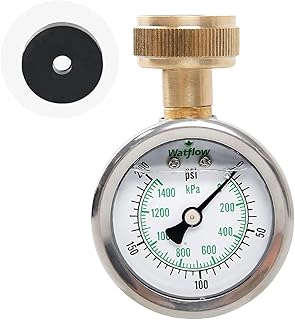
0-200 PSI
Glycerin-filled
3/4" thread
What is it and what's it for?
It's a gauge that screws straight onto your spigot and tells you, in numbers (PSI), how hard the water in your system is actually pushing — like the gauge a tire shop uses to check air pressure, but for the water coming out of your house. Without that number, picking a pump or a pressure regulator is a guessing game: you either buy something you didn't need, or under-buy and the problem stays.
Real-world use cases
At home
You notice your drip kit spraying instead of dripping, or two sprinklers losing force when they run together. Instead of guessing whether pressure is the issue, you screw this gauge onto the spigot, open it all the way, and get the exact number in seconds: below 40-45 PSI while running several sprinklers at once points to low pressure; above 60-70 PSI feeding a drip kit (rated for 20-45 PSI) is exactly when you need a regulator.
In a business or workshop
An irrigation installer quoting jobs at different homes or businesses can carry this gauge in the toolbox and measure each site's real pressure on the spot, before recommending — or over-selling — a surface pump or a regulator. A 30-second check that keeps you from installing the wrong equipment.
How to avoid buying the wrong one
Confirm your spigot has a standard 3/4" thread (the same one any garden hose uses) — this gauge screws on directly, no extra adapters needed.
Pick a glycerin-filled gauge like this one, not a dry one: the glycerin dampens the needle's shake when you open the tap all the way, and without it the reading jumps around and is hard to read precisely.
It's a diagnostic tool, not a fix — it measures the problem, but solving it still takes the right product afterward (a surface pump if pressure is low, or a regulator like the Orbit 67798 in this ranking if it's too high).
The investment takeaway
It costs less than two coffees, but it saves you from this category's most expensive mistake: buying a $150-350 surface pump you didn't actually need, or installing a drip kit with no regulator and ending up replacing blown-out emitters one by one. Measure first, buy second — this gauge is the difference between spending with certainty and spending on a guess.
Watflow Water Pressure Gauge for Hose Bib/Spigot (0-200 PSI, Glycerin-Filled)
What is the Watflow Water Pressure Gauge for Hose Bib/Spigot (0-200 PSI, Glycerin-Filled) for?
It's a gauge that screws straight onto your spigot and tells you, in numbers (PSI), how hard the water in your system is actually pushing — like the gauge a tire shop uses to check air pressure, but for the water coming out of your house. Without that number, picking a pump or a pressure regulator is a guessing game: you either buy something you didn't need, or under-buy and the problem stays.
Who is it a good fit for?
Confirming your spigot's real pressure before deciding whether you need a surface pump, a pressure regulator for a drip kit, or neither.
What should I know before buying it?
A glycerin-filled gauge (dampens the needle's shake for a steady reading) with a standard 3/4" female garden-hose thread — screws straight onto a spigot, no tools needed. It's the diagnostic piece this catalog was missing: both the pump guide and this ranking's pressure regulator talk about measuring real pressure before buying, but until now there was no product to actually do that. 0-200 PSI range, far more than any home pressure will ever hit.
Is it worth it?
It costs less than two coffees, but it saves you from this category's most expensive mistake: buying a $150-350 surface pump you didn't actually need, or installing a drip kit with no regulator and ending up replacing blown-out emitters one by one. Measure first, buy second — this gauge is the difference between spending with certainty and spending on a guess.
How much does it cost?
The reference price is $8.99 on Amazon. It can change, so check the current price before buying.
Field glossary
Terms you'll hear about this equipment
So you can use the right vocabulary with a customer, a supplier, or a manual.
PSI (Pounds per Square Inch) — PSI — Libras por pulgada cuadrada
La unidad con la que se mide la presión del agua — cuanto más alto el número, más fuerza tiene el chorro.
Includes a 5/16" main line (50 ft) plus 1/4" tubing and 40 emitters, with quick-connect fittings that make it easy to add or move drippers without tools. Rated for 20-45 PSI — household mains pressure is usually higher than that, so you'll need a pressure regulator at the inlet (check the listing to confirm whether one is included).
Unlike the previous kit (pure drip), this one uses 32 adjustable brass nozzles for micro-spray/misting — it covers a wider area per point, better suited to flower beds or seedling trays than individual potted plants. If you're after precise drop-by-drop watering, the Bonviee kit above is the more accurate option.
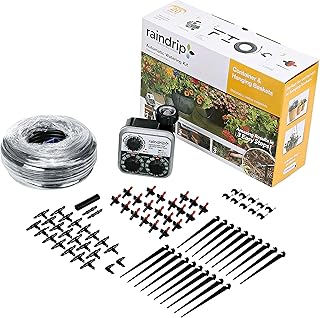
Unlike the Bonviee and Bluepro kits in this ranking (built for rows of plants in the ground or flower beds), this one is designed specifically for pots and hanging baskets — up to 20 plants. It includes a battery-powered mechanical timer (no WiFi/smart features) and 75 ft of 1/4" tubing, with quick-connect fittings for a three-step install. If you want ground-level garden coverage, the row-oriented kits in this ranking are the better choice.