HIDRO_LAB

Irrigation pump calculator

Enter your system's data and we tell you the flow and pressure the pump has to deliver. With that operating point you compare against the manufacturer's curve, not against horsepower.

Example values loaded (4-rotor zone fed from a cistern). Replace them with your own.

Sum of the emitters in ONE zone (the pump waters one zone at a time).

Prefer to work it out? Emitters in the zone × flow of each

×GPM

At the sprinkler or dripper, from its data sheet (not at the pump).

0 if the pump is submersible or below the water.

From each part's manufacturer data; if unknown, a few PSI.

Operating point the pump must cover

Look for a pump whose curve passes through this point or above it:

10.0 GPM at 57.3 PSI

≈ 132 ft of water column · Equivalent flow: 38 L/min · 10.0 GPM · 600 GPH

Pressure breakdown

Pressure at the emitter35.0 PSI
Pipe friction3.6 PSI
Elevation5.2 PSI
Suction4.3 PSI
Valves and fittings4.0 PSI
Subtotal52.1 PSI
Margin (10%)+5.2 PSI
Total57.3 PSI

Water velocity in the pipe: 3.7 ft/s

With 1 1/4" pipe the friction on that run would drop to 0.9 PSI (saving 2.6 PSI).

How the calculation works

The pump has to overcome four things, added up in PSI: the pressure the emitter needs, water friction in the pipe, the elevation gain (0.433 PSI per foot, or 0.098 bar per metre) and the suction lift if the pump sits above the water level. On top of that come the loss in valves and fittings and a safety margin.

Friction is calculated with the Hazen-Williams equation for smooth PVC (coefficient C = 150) and the real inside diameters of schedule 40 pipe (3/4" = 0.824 inches, 1" = 1.049, 1 1/4" = 1.380, 1 1/2" = 1.610, 2" = 2.067). Water velocity comes from flow ÷ pipe cross-section.

What it covers and what it does not

  • It is a basic engineering estimate for sizing and comparing, not a certified design, and it does not replace the pump's real curve.
  • It assumes one zone running at a time, straight PVC pipe of a single diameter, and fresh water at room temperature. Polyethylene pipe, hose, steel or several diameters in series give different losses.
  • Loss in valves, filters and fittings is entered by you: use each manufacturer's figure.
  • It does not size the pressure tank or the electrical consumption, and it does not check the real capacity of your well or cistern.

With the result in hand

  1. Find the pump curve (the seller or manufacturer publishes it) and mark your flow on the horizontal axis.
  2. The pressure the curve gives at that point must be greater than or equal to the calculated total.
  3. Ideally your point falls in the middle section of the curve, not at the extreme.

To see the reasoning step by step with a worked example, read the guide How to calculate an irrigation pump: GPM, PSI and head. To compare pumps by flow and price: pump ranking.

Frequently asked questions

How do I work out which irrigation pump I need?

You need the flow of the largest zone that runs at once, the total pressure (emitter pressure plus friction, elevation, suction lift and fittings) and to compare it with the pump curve. This calculator gives you that operating point in GPM and PSI.

What is the difference between GPM and L/min?

1 GPM (gallon per minute) equals 3.785 litres per minute. US pump listings use GPM and PSI; the calculator converts to the metric system automatically if you choose it.

How much safety margin should I leave?

It is common to leave 10 to 20% above the calculation, because pumps wear and pipes get dirty over time.

How high can a surface pump lift water by suction?

At sea level the physical limit is about 34 feet (10.3 m), but in practice surface pumps work well up to about 20 to 25 feet (6 to 7.6 m) of suction lift. Deeper than that you need a submersible pump.

Does it work for drip irrigation?

Yes, as long as you enter the zone's total flow (drip is often rated in gallons per hour: divide by 60 to get GPM) and a low inlet pressure, normally 10 to 30 PSI after the regulator.

Why can a larger pipe be better than buying a bigger pump?

Because friction grows very quickly with flow and drops a lot when the diameter goes up. On long runs, going from 1" to 1 1/4" often cuts several PSI for less money than a more powerful pump.
Parts that complete the installation

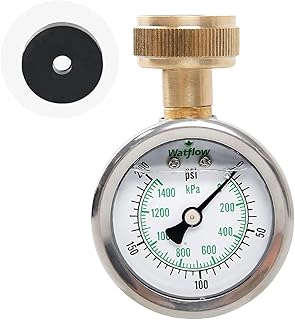
#7Watflow Water Pressure Gauge for Hose Bib/Spigot (0-200 PSI, Glycerin-Filled)

Watflow Water Pressure Gauge for Hose Bib/Spigot (0-200 PSI, Glycerin-Filled)

0-200 PSIGlycerin-filled3/4" thread
4.5 · 734 reviews

A glycerin-filled gauge (dampens the needle's shake for a steady reading) with a standard 3/4" female garden-hose thread — screws straight onto a spigot, no tools needed. It's the diagnostic piece this catalog was missing: both the pump guide and this ranking's pressure regulator talk about measuring real pressure before buying, but until now there was no product to actually do that. 0-200 PSI range, far more than any home pressure will ever hit.

#7
🏆 Best seller⭐ Top rated
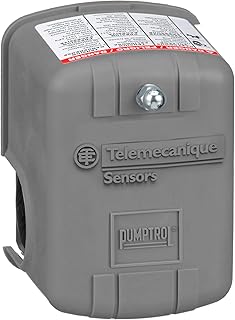
Square D FSG2J24CP — Pumptrol Pressure Switch for Well Pumps (40-60 PSI)

Square D FSG2J24CP — Pumptrol Pressure Switch for Well Pumps (40-60 PSI)

Pressure switch40-60 PSISquare D
4.7 · 1,105 reviews

This is the pressure switch that automatically turns a well pump (jet or submersible) on and off based on the water pressure in the pipe — the Square D/Telemecanique brand is the industry reference for this part in the US, backed by over 1,100 reviews. It ships factory-set to the 40-60 PSI range (on at 40, off at 60), adjustable via the range-spring nut if your pump needs a different setting. Real limitation: this is NOT a pressure tank, it's only the switch — both the Red Lion and the WAYNE SWS50 in this ranking ship without a pressure switch or tank, and without a separate pressure tank added to the system, the pump will short-cycle (turn on and off every few seconds), which significantly shortens motor life.

#8Amtrol WX-202 — 20-Gallon Pre-Charged Pressure Tank (Well-X-Trol)

Amtrol WX-202 — 20-Gallon Pre-Charged Pressure Tank (Well-X-Trol)

Pressure tank20 gallons38 PSI pre-charge
4.6 · 225 reviews

A pre-charged bladder tank with a butyl-rubber diaphragm, factory pre-charged to 38 PSI — 2 PSI below the cut-in point of a 40-60 PSI switch, like the Square D FSG2J24CP in this ranking, which is exactly the range it ships calibrated for. System connection is 1" NPT, max working pressure 125 PSI. Real limitation: 20 gallons is the standard residential size, but if your home has multiple bathrooms or draws water at several points at once, the Well-X-Trol family also comes in larger sizes — this one can fall short in those cases.

#9H2O PRO Brass Foot Valve 3/4" — Check Valve with Strainer for Well Jet Pumps

H2O PRO Brass Foot Valve 3/4" — Check Valve with Strainer for Well Jet Pumps

Foot valve3/4" brassCheck valve + strainer
4.5 · 44 reviews

Installs at the end of the suction hose or pipe, inside the well or cistern — not on the pump itself. It's a one-way check valve (lets water flow toward the pump, but not back) with a built-in strainer that blocks coarse sediment. Without this part, a non-self-priming jet pump like the WAYNE SWS50 in this ranking loses its prime every time it shuts off, because water in the suction hose drains back down into the well by gravity. 3/4" NPT thread (also sold in 1" for higher-flow setups — confirm your suction hose diameter before buying). Real limitation: it's brass, not reinforced plastic, so it's heavier and needs to sit properly on the bottom of the well/cistern so the strainer doesn't clog with loose silt.

Affiliate disclosure: HidroLab is a participant in the Amazon Services LLC Associates Program. We earn a commission on qualifying purchases made through our links, at no extra cost to you. Prices shown are reference prices — the actual price is only confirmed on Amazon.