How to Water Your Garden (or Vegetable Patch) While on Vacation With No One to Check On It
Every year it's the same story: you book the trip, and at some point before leaving, the thought hits — "who's going to water the plants?" Asking a neighbor works once — for longer or more frequent trips, the real fix is automating watering while you're gone, not relying on someone remembering.
How long you're away changes the answer
A long weekend (2-4 days): most potted plants can handle going without water that long, especially if you move them into the shade before leaving. If you're not sure, you don't need a full drip kit for such a short trip — a garden hose plus the Orbit 62034 is enough, a mechanical faucet timer under $10: wind the dial to the time you want (15 to 120 minutes) and it shuts the water off on its own, no batteries or WiFi involved. One catch — it's single-cycle, it doesn't repeat the schedule every day like the digital timer in the HEKIWAY kit below, so it's built for this one short trip, not for running for weeks.
One to two weeks: at this point, "hanging in there" isn't enough — you need a system that actually waters every day, at the right time, without anyone touching anything. If you don't have anything set up yet, a kit with a built-in timer, like the HEKIWAY 60ft with timer, makes more sense than putting together the hose and timer separately: you set it up once and forget about it. But if you already have a hose or a drip kit running and all you're missing is watering that repeats on its own while you're gone, you don't need to buy a whole new kit: the Orbit 62061 is a standalone digital timer that screws onto your existing faucet — unlike the mechanical Orbit 62034 above, you program the duration and frequency once (every 6, 12 hours, or every 1 to 7 days) on its LCD screen and the unit repeats the cycle on its own, day after day, with no rewinding needed. It costs more than the mechanical one (~$30 versus under $10) but far less than setting up a new WiFi system if all you're missing is the automatic repeat, not remote control.
More than two weeks, or you travel often: here it's worth stepping up to a real WiFi controller, not just a battery timer. The difference matters: with WiFi you can check from your phone that watering is actually running, and if the weather changes (a heat wave, a storm), you can adjust the schedule remotely instead of trusting that the timer you set before leaving is still right two weeks later.
The most common mistake: buying the wrong kit because you rushed the purchase
Not all drip kits are the same, and the key difference before a trip is simple: does it come with a timer or not?
- The MIXC 50 ft kit is the most affordable in the catalog, but the manufacturer states clearly that it does not include any timer — if you buy it thinking you'll automate watering for the trip and don't add a separate timer, you'll land at your destination with the system installed but with nothing to turn it on by itself. The missing piece is one of this catalog's two hose-bib timers: the Orbit 62034 (mechanical, under $10, single cycle) for a short one-off trip, or the Orbit 62061 (digital, ~$30, repeats the cycle on its own every day) if you'll be away for one or two weeks. It also doesn't come with quick-connect fittings like the Bonviee below, so if you plan on disconnecting the hose often (to wash the car, say), it's worth adding a set like the HQMPC brass 3/4" quick connect: same result as the Bonviee's built-in connector, just as a separate, cheaper part, since the MIXC doesn't ship with one.
- The HEKIWAY kit with timer included solves this in a single purchase: tubing, nozzles, and the timer already come together, so there's no risk of putting everything together and realizing at the airport that the piece that makes it run on its own is missing.
- The Bonviee 247 ft kit is the pick if your yard is bigger than what the MIXC covers: quite a bit more line (247 ft versus 50 ft) and quick-connect fittings to add or move emitters without tools — but it doesn't come with a timer either, so the same rule applies: without adding a separate timer (like the Orbit 62034 or 62061 above), it won't turn itself on while you're away. The difference versus the MIXC+HQMPC combo above is that here the quick connector ships built in, while with the MIXC it's a part you add on your own — plug-and-play versus DIY, same end result.
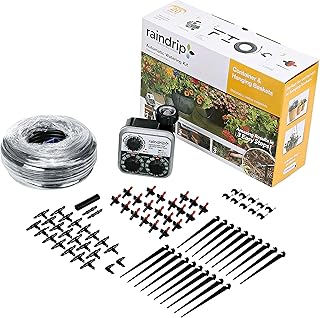
- If your specific case is pots and hanging baskets (not rows in the ground like the kits above), the Raindrip R560DP solves the timer problem in a single purchase: it's built specifically for up to 20 potted or hanging plants, with the battery-powered mechanical timer already included in the same kit — the same logic as the HEKIWAY above, but sized for a balcony or entryway rather than a garden bed or vegetable patch.
If you don't even have a faucet nearby: an apartment, office, or balcony with no running water
Every kit above — MIXC, Bonviee, HEKIWAY, Raindrip R560DP — starts from the same assumption: it screws onto an outdoor faucet and needs mains water pressure (20-45 PSI) to work. If you live in an apartment with no faucet on the balcony, or want to automate watering for plants in an office with no water access nearby, none of those kits will help you, no matter how you tune the pressure regulator in the next section.
If your case is even smaller — a handful of pots, not ten or fifteen — you don't even need a pump: the Modern Innovations terracotta spikes push into each pot's soil and hold an upside-down reused water bottle (1-2 liters, not included), which seeps through the porous ceramic on its own for 7 to 10 days. It's the simplest and cheapest option in this entire ranking — no batteries, no pump, no bucket to refill — but it doesn't scale: each spike covers a single pot, so for ten or fifteen plants you end up filling bottles one by one instead of solving it in one shot. That's where a pump makes more sense. The RAINPOINT Automatic Indoor Plant Waterer is built for exactly that case: instead of connecting to the mains, it's a battery-powered pump that sits in a bucket or container of water and distributes it through thin tubing to up to 10 potted plants (15 with the manufacturer's expansion kit). You set duration and frequency with two dials — no WiFi or app — and a low-water LED warns you before the bucket runs dry and the pump starts running on air. The real trade-off: you have to manually refill the bucket every so often, so for a trip longer than a week it's worth estimating how much water it'll use beforehand, or asking someone to handle the simple task of topping off water, without needing them to actually water anything themselves.
The accessory nobody thinks about until a line bursts while you're away
Both the MIXC and the Bonviee kits are rated for 20-45 PSI, but an average home's tap usually delivers 40 to 80 PSI — well above what the kit can handle. When you're around, you notice right away if an emitter starts spraying instead of dripping; while you're traveling, nobody catches it until you get back to a flooded bed (or a dry one, if the line lost pressure) and the rest of the pots never got a drop. Before you leave, the cheapest way to know if this problem applies to you is to screw a pressure gauge onto the spigot and read the real number: if it's above 45 PSI, add a pressure regulator with a built-in filter at the inlet, between the spigot and the kit — it locks the pressure at 30 PSI (within what both kits are rated for) and filters out the sediment that could clog emitters while there's no one around to unclog them. The gauge costs under $10 and tells you whether you actually need the regulator; buying the regulator without measuring first is spending blind, and skipping it when you do need it is the most common cause of a burst line running unchecked for two weeks.
A safety issue that isn't pressure: keeping water from flowing back into your pipes
Beyond pressure, there's a separate problem none of the kits in this ranking solve on their own: if mains pressure ever drops (a water main break down the street, for example) while the kit is connected and set up, the water sitting in the drip line — carrying dirt, bugs, or fertilizer if you ever add one — can get siphoned back into your house's drinking water pipes. That's exactly the "I left everything hooked up and went on a trip" scenario this guide is trying to solve, and it's what most plumbing codes require for any irrigation connection to an outdoor hose bib. Neither the MIXC, the Bonviee, the HEKIWAY, nor the CARPATHEN in this ranking include this protection. The Raindrip R620CT backflow preventer screws directly onto the hose bib, before the pressure regulator and before the kit, and costs under $10: while water flows it stays sealed, and the moment the water shuts off it opens to let air in and break the suction. Unlike the Rain Bird anti-siphon valve in this catalog — built for a wired 24V solenoid valve system — this part needs no power or wiring: it's the right choice when your drip kit connects straight to the hose bib with no controller in between.
If your situation is specifically a raised bed or a vegetable garden
The kits above (MIXC, HEKIWAY) are built for general garden use — pots, beds, scattered plants. If your specific case is a raised garden bed or a vegetable patch, the CARPATHEN 100 ft kit is built specifically for that: 30 adjustable emitters, a thicker mainline (5/16 instead of the standard 1/4), and it throws in a digital vegetable-growing guide — handy if, on top of automating watering, you want the garden to actually produce while you're away. Like the MIXC and Bonviee, it's limited to 20-45 PSI and 40 GPH, so the same pressure-gauge advice above applies before you travel.
If your yard is bigger than a few pots but isn't quite a lawn
A flower bed, a long garden row, or a seedbed sometimes needs more coverage than a single point-source emitter gives, without quite justifying a zoned controller yet. The Bluepro 200 ft kit fills that middle ground with brass micro-sprinkler nozzles instead of drop-by-drop drip: it covers a wider area per point, at the cost of the precision the kits above offer — better suited to a flower bed or seedbed than to individual potted plants, where the MIXC or the Bonviee remain the more precise choice. The pressure check matters even more here than with the pure drip kits: measure with the same pressure gauge mentioned above before installing it, because a brass nozzle that gets more pressure than it's rated for doesn't just drip extra, it pops off — if it reads above 45 PSI, add the Orbit 67798 regulator with filter at the inlet.
If you have a lawn or a bigger yard (not just pots)
A drip kit is enough for pots, garden beds, and raised vegetable gardens, but it doesn't replace a zoned irrigation system for a lawn. If your trip falls during summer and you have grass to look after, a 4- or 8-zone WiFi controller with rain auto-skip is the investment that actually lets you travel worry-free — it cancels watering on its own if it rains while you're away, instead of watering in the rain the way a fixed timer would.
Before you leave: the 3-minute checklist
- Test the system 2-3 days ahead of time, not the night before your flight — that gives you room to fix a misaligned nozzle or a timer that didn't save the schedule.
- Group your thirstiest pots along the same drip line — it's easier to adjust the flow for a whole zone than for one lone pot.
- If you're using a battery timer, swap the batteries before you leave, not when they're already dying — it's the number-one reason an "automatic" system quietly shuts off mid-trip. For the HEKIWAY kit's timer specifically, the manufacturer's official manual confirms this doesn't leave you completely in the dark: the battery lasts about a year under normal use, and if it dies during your trip the timer shuts the valve on its own (instead of watering uncontrolled) and saves your schedule for when you replace it.
Video: how to install the mechanical faucet timer
If your plan is the short trip from point 1 (a long weekend with a simple timer instead of a full kit), this video shows the real installation and use of the Orbit 62034 on a standard hose faucet.
Video: the digital timer for longer trips
If your plan is the one-to-two-week scenario and you already have a hose or kit set up, this video shows real use of a single-outlet digital faucet timer like the Orbit 62061 — programming duration, frequency, and rain delay on the LCD screen.
Video: do terracotta spikes actually work?
If your plan is the few-pots, no-pump-or-kit scenario from the section above, this independent video puts terracotta spikes to a real test and gives an honest verdict on how well (or poorly) they hold moisture over several days.
Our pick of the month
For raised vegetable gardens and small-to-medium beds, the HEKIWAY kit with timer included is the lowest-effort option before a trip. If your situation is bigger (a lawn, several zones), check the guide on how to choose a WiFi irrigation controller before deciding which one fits your yard.
Frequently asked questions
Can I leave the system running all summer, not just for the trip? Yes — there's no reason to take it apart when you get back. In fact, once you've confirmed it works well while you're away, it makes sense to keep it as your regular watering system and skip the manual chore the rest of the year.
What if the power or WiFi goes out while I'm traveling? Battery timers (like the one in the HEKIWAY kit) don't depend on WiFi or your home's power — they keep following the programmed schedule regardless. WiFi controllers do need a connection for you to control them remotely, but most keep running the last saved schedule even through a brief internet outage.
Is there anything else I need besides the pressure regulator before connecting the kit to the bib and leaving worry-free? Yes, and it's a different problem than pressure: without a backflow preventer, if mains pressure drops at any point while you're traveling, water in the drip line can get siphoned back into your house's pipes. The Raindrip R620CT solves exactly that for under $10, with no batteries or wiring — it installs first, right at the bib, with the pressure regulator and the kit coming after it.
What's the real difference between the mechanical and the digital faucet timer in this catalog? The mechanical Orbit 62034 is single-cycle: you wind it, it waters for that time, then shuts off, and for the next watering you have to rewind it by hand — good for a short, one-off trip. The digital Orbit 62061 does the same job but with memory: you program the duration and how often to repeat it once, and the unit remembers on its own, day after day, until you change it, with no WiFi required. For a weekend, the mechanical one is enough and cheaper; for one or two weeks without having to reset anything, the digital one is the better fit.
Does the RAINPOINT indoor waterer replace this ranking's faucet-based drip kits? No, it solves a different problem: every kit in this ranking (MIXC, Bonviee, HEKIWAY, CARPATHEN, Raindrip R560DP) needs to screw onto a faucet with mains pressure. The RAINPOINT is for when that faucet doesn't exist — an apartment, an office, a balcony with no running water — because it draws from a bucket instead of the mains. If you do have a faucet available, any of the kits above will give you more coverage and less manual upkeep than having to refill a bucket every so often.
What happens if the HEKIWAY kit's timer runs out of batteries mid-trip? The manufacturer's official manual specifies a "Low Power Auto-Shutoff" feature: when the battery drops to a critical level, the timer closes the valve on its own to cut off the water instead of leaving it watering uncontrolled or stuck in some position, and it saves your schedule for when you replace the batteries (declared battery life of about one year under normal use). The same manual warns against using it with water above 40°C/104°F or below 0°C/32°F, and recommends disconnecting it before the first winter frost. We don't have this same official confirmation for the Orbit 62034 or Orbit 62061 in this catalog, so if your kit is one of those two, follow the general rule from point 3 of the checklist above: swap the batteries before you leave, not once they've already warned you they're low.
Related products
See full ranking →
Bonviee 247 ft Drip Irrigation Kit (Quick Connect)
Includes a 5/16" main line (50 ft) plus 1/4" tubing and 40 emitters, with quick-connect fittings that make it easy to add or move drippers without tools. Rated for 20-45 PSI — household mains pressure is usually higher than that, so you'll need a pressure regulator at the inlet (check the listing to confirm whether one is included).

Bluepro 200 ft Micro-Sprinkler Kit (Brass Nozzles)
Unlike the previous kit (pure drip), this one uses 32 adjustable brass nozzles for micro-spray/misting — it covers a wider area per point, better suited to flower beds or seedling trays than individual potted plants. If you're after precise drop-by-drop watering, the Bonviee kit above is the more accurate option.
Raindrip R560DP — Drip Kit with Timer for Pots and Hanging Baskets
Unlike the Bonviee and Bluepro kits in this ranking (built for rows of plants in the ground or flower beds), this one is designed specifically for pots and hanging baskets — up to 20 plants. It includes a battery-powered mechanical timer (no WiFi/smart features) and 75 ft of 1/4" tubing, with quick-connect fittings for a three-step install. If you want ground-level garden coverage, the row-oriented kits in this ranking are the better choice.